
Is Brooks Eye Associates in Plano the right next contact?
At Brooks Eye Associates, we offer advanced cataract surgery and premium lens technology. We provide premium vision correction treatments in Plano and surrounding communities. Your next decision is not whether a particular lens name sounds attractive; it is whether an evaluation can connect your visual priorities and eye measurements with an appropriate cataract-care plan.
A Plano cataract evaluation is a suitable next contact when you want to understand whether cataract surgery fits your situation, what lens categories may be discussed, and how your eyes and daily visual needs shape the conversation. We offer assistance for individuals ready to restore their vision through cataract surgery. We provide comprehensive evaluations. An evaluation gives you a place to ask focused questions without selecting a lens in advance. You can describe the visual tasks that matter to you, then discuss how eye measurements and ocular health relate to the available options. Cataract surgery and lens technology are appropriate topics for that conversation, but a general description does not identify a lens for every person or establish when surgery should occur. That conversation can cover the basic surgical change, the role of an artificial lens, and the categories that may be discussed. It can also separate general explanations from questions that depend on eye measurements and ocular health. If your question is whether Brooks Eye Associates in Plano is relevant to your cataract-care search, requesting an evaluation is the concrete way to move from general descriptions to a conversation about your own needs.
The cataract-care decision has a clear boundary: a general description of lens types cannot establish your candidacy, timing, or final lens recommendation. Use this guide to prepare for a focused conversation about your eyes, visual priorities, and available options rather than to choose an implant from an online description. You can contact us with questions about the cataract-surgery process before deciding whether to request an evaluation.
Begin with an evaluation rather than a lens preference
An ophthalmic evaluation is the starting point for discussing cataract-care timing and lens selection, rather than a predetermined implant. The discussion can then connect the visual tasks you want to prioritize with the measurements of your eyes; a lens label alone does not settle the conversation.
An ophthalmic evaluation connects three parts of the decision:
- The condition being addressed: Cataract surgery removes the cloudy natural lens and replaces it with an artificial intraocular lens.
- The optical details of your eyes: Measurements of eye length and corneal curve help determine the IOL’s focusing power.
- Your practical visual priorities: Lifestyle, ocular health, and long-term vision needs inform the personalized recommendation discussed with you.
This approach keeps a lens label from becoming a substitute for the information needed to discuss surgery.
A discussion about timing should answer what you need to know before moving forward, rather than force you to arrive with a date or implant already chosen. Ask how your present visual concerns relate to the cataract conversation, what the evaluation is designed to determine, and which findings would shape the next discussion. We can provide assistance for people considering cataract surgery, so you can use the appointment to organize the timing and lens questions that matter to you.
One way to keep this conversation organized is to separate it into three layers. First, identify the change being considered: removing the cloudy natural lens and replacing it with an artificial IOL. Second, identify the information the ophthalmologist uses: measurements of eye length and corneal curve help set the IOL’s focusing power. Third, describe the visual priorities that make one lens discussion more relevant than another, such as a primary distance, near and intermediate range, astigmatism correction, or possible continued use of glasses. This sequence shows why a preferred lens name cannot replace the evaluation. It also gives you a way to ask about timing without assuming that an online description can determine when surgery should be considered. If a lens category seems attractive, bring it forward as a question and ask which part of the evaluation would bear on it.
What cataract surgery changes
Cataract surgery removes the cloudy natural lens and replaces it with an artificial intraocular lens, or IOL. The operation therefore changes the eye’s focusing element rather than simply placing a stronger pair of glasses in front of the eye. Understanding that basic change helps explain why the lens implant is part of the surgical conversation.
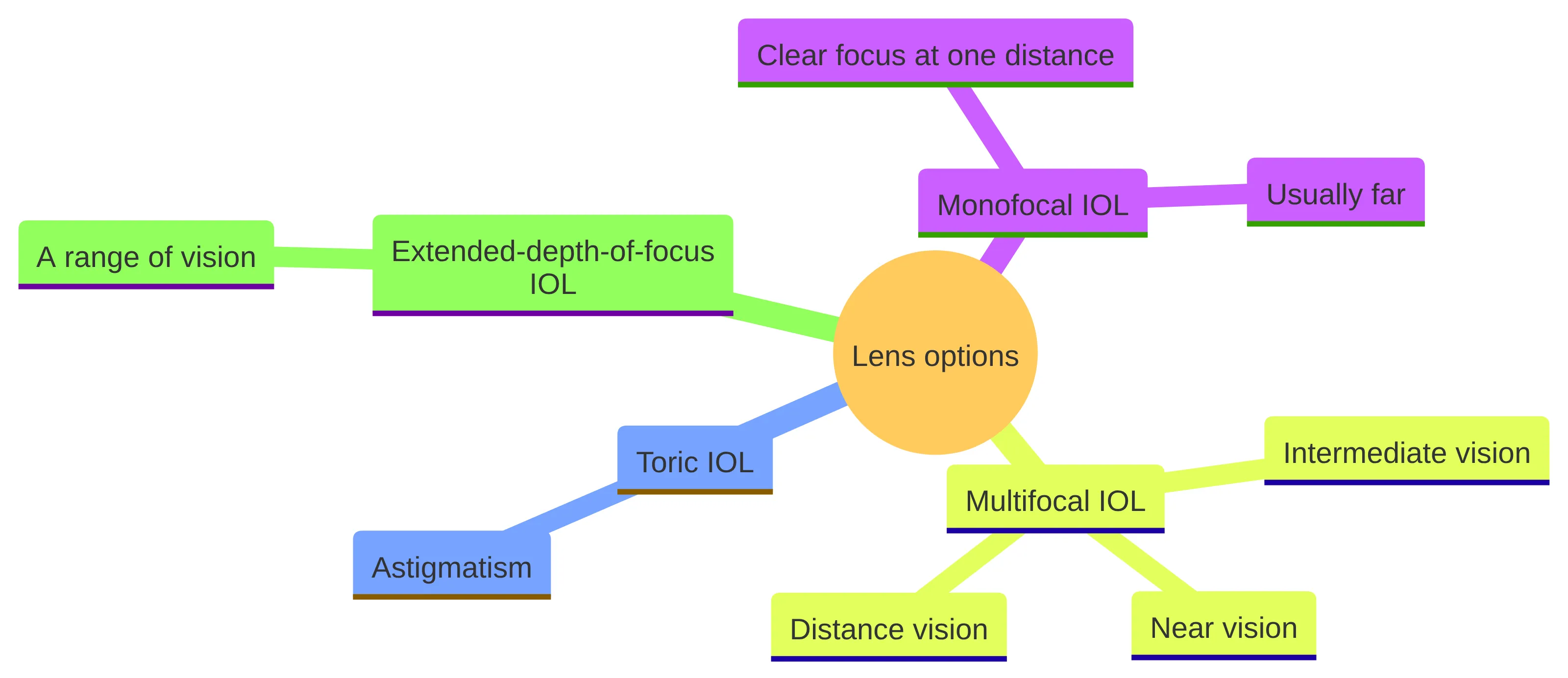
An intraocular lens is selected with a focusing power calculated from measurements of the eye’s length and the cornea’s curve. IOL categories then describe different intended visual roles. A monofocal lens focuses clearly at one distance, usually far, while multifocal lenses can provide near, intermediate, and distance vision and may reduce the need for glasses. Toric IOLs are designed to correct astigmatism while addressing the cataract.
The IOL choice affects the visual goal you bring to the consultation. A desire to emphasize distance clarity is a different starting point from a desire to reduce reliance on glasses across several distances, and astigmatism creates another question for the discussion. These descriptions do not predict your result or establish which lens belongs in your eyes; the evaluation should connect the available option with your measurements and visual needs.
Compare lens options by the visual goal
Lens options answer different visual questions, so compare them by the task you want to discuss rather than by the word premium alone.
| Lens option | Visual goal or eye factor | What the option is designed to address | Question to bring to the evaluation |
|---|---|---|---|
| Monofocal IOL | Clear focus at one distance, usually far | A single primary focusing distance; glasses may still be needed for near work | Which distance should be prioritized, and what near tasks may still require correction? |
| Toric IOL | Astigmatism during cataract surgery | Correction of astigmatism while addressing the cataract | Do my eye measurements make astigmatism correction part of the lens discussion? |
| Multifocal IOL | Near, intermediate, and distance vision | A range of vision that may reduce reliance on glasses, although you may still need corrective lenses | How do my visual needs and eye health affect whether this range-of-vision option is appropriate? |
| Extended-depth-of-focus IOL | A range of vision | A lens designed to provide a range of vision and may reduce dependence on glasses | Which visual distances does this option fit, and what role would glasses still have for me? |
Your visual goal is the useful comparison point. Monofocal lenses keep the conversation centered on one clear distance, usually far. Multifocal lenses address near, intermediate, and distance ranges, but you may still need corrective lenses. Toric lenses focus on astigmatism as part of cataract surgery. Extended-depth-of-focus lenses are designed around a range of vision and may reduce dependence on glasses. None of these descriptions is a personal recommendation.
A second useful distinction is that the options do not all address the same dimension of the decision. Monofocal, multifocal, and extended-depth-of-focus descriptions primarily concern the distance or range of vision the lens is designed to address. Toric describes the astigmatism question during cataract surgery. Those questions can overlap: someone may want a particular distance or range while also needing to discuss whether astigmatism is part of the lens conversation. The categories therefore should not be treated as a single ladder from basic to best, and the word premium does not identify a universal winner. Use the table to identify the relevant question, then ask how the ophthalmologist would connect that question to your eye measurements, ocular health, and visual needs. Light adjustable lenses should be handled in the same question-led way: the practice identifies them as an available cataract lens option, but the information here does not assign them a visual role for every patient. Ask what role, if any, the option would have in your evaluation rather than inferring it from the name.
A useful comparison starts with the visual activities that matter in your routine: distance viewing, reading, intermediate tasks, or the effect of astigmatism on the discussion. Bring those priorities to the evaluation in plain language. We use evaluations based on lifestyle, ocular health, and long-term vision needs to support personalized recommendations, so the purpose of comparing options is to improve the questions you ask rather than to choose an implant before examination.
Where extended-depth-of-focus and light adjustable options fit
Extended-depth-of-focus IOLs are designed to provide a range of vision and may reduce dependence on glasses. That description gives you a useful starting question: which distances does the proposed option address for your visual routine, and where might corrective lenses remain part of your plan? The answer must be connected to your eyes and visual needs rather than to the lens category alone.
Light adjustable lenses are among the lens implant options identified with our cataract service. We offer advanced cataract surgery and premium lens technology, while our evaluations support personalized recommendations based on lifestyle, ocular health, and long-term vision needs. A light adjustable option therefore belongs in the evaluation conversation, where you can ask what role it has for your eyes, what visual goal it is intended to address, and how the ophthalmologist will decide whether it is appropriate.
Availability and suitability are separate points. Knowing that a light adjustable lens is among the options identified with the cataract service tells you that it can be raised during the appointment; it does not tell you what visual goal it would address for your eyes. Keep the question specific: Which part of my visual routine would this option be intended to address? What measurements or ocular-health considerations would the ophthalmologist review? How would it compare, for my stated priorities, with a monofocal, toric, multifocal, or extended-depth-of-focus discussion? Would corrective lenses still be part of the conversation for some tasks? These questions do not presume an answer. They keep the discussion focused on connecting the option to information that is individual to you. The same discipline applies to every lens category: an online description can explain a role, but it cannot select an implant, establish candidacy, or set timing.
A premium lens label does not determine candidacy or guarantee a particular visual experience. The practical boundary is simple: treat extended-depth-of-focus and light adjustable lenses as options to evaluate, not as conclusions to reach from an online description. Ask the ophthalmologist to connect each option with your measurements, ocular health, visual priorities, and expectations for corrective lenses.
How measurements and visual priorities shape the recommendation
IOL focusing power depends on measurements of the eye’s length and the curve of the cornea. Those measurements give the ophthalmologist information needed to set the implant’s focusing power; they are not replaced by your preferred lens category. This is why a lens discussion follows an evaluation instead of standing in for one.
Your visual priorities shape the recommendation alongside those measurements. Our evaluation approach considers lifestyle, ocular health, and long-term vision needs, while the broader IOL guidance connects the appropriate option to your eyes and visual needs. Explain the distances and tasks you want to discuss, including whether your priorities center on distance, near work, intermediate viewing, reducing reliance on glasses, or addressing astigmatism.
A focused evaluation conversation can follow this sequence:
- Describe your visual priorities. Explain which distances and daily tasks matter most to you.
- Ask how the eye measurements affect focusing power. Eye length and corneal curve are used to set the IOL’s focusing power.
- Discuss the relevant lens categories. Ask how monofocal, toric, multifocal, extended-depth-of-focus, or light adjustable options relate to your situation.
- Clarify the recommendation’s limits. Ask what the proposed lens is designed to address and whether you may still need corrective lenses for some tasks.
This sequence keeps the discussion tied to your eyes, your visual priorities, and the information gathered during the evaluation.
Questions to clarify before requesting cataract care
Questions about cataract care can keep your appointment focused and help you understand how the recommendation is formed:
- What findings would determine whether cataract surgery is appropriate for me?
- How do the length of my eye and the curve of my cornea affect the IOL’s focusing power?
- Which visual distance should I prioritize based on my daily activities?
- If astigmatism is part of my eye measurements, should a toric IOL be discussed?
- How would a multifocal or extended-depth-of-focus option relate to my need for near, intermediate, and distance vision?
- What role could a light adjustable lens have in my evaluation?
- Which lens categories may reduce reliance on glasses, and for which tasks might corrective lenses still be needed?
- How do my ocular health and long-term vision needs affect the recommendation?
- What questions should I answer before discussing a proposed lens with the ophthalmologist?
A cataract-care question list is a preparation tool, not a substitute for examination. The list helps you connect the basic surgical change, the available lens roles, and your own priorities in one conversation. We offer assistance for people considering cataract surgery, and you can contact us with questions about the process before deciding whether to request an evaluation.
Before contacting the practice, it can help to write a short four-part note:
- Your visual tasks: name the distances and activities you want to discuss, such as distance viewing, reading, or intermediate work.
- Your lens questions: identify whether you want clarification about one-distance focus, a range of vision, astigmatism, or the light adjustable option.
- Your evaluation questions: ask how eye length, corneal curve, ocular health, and long-term vision needs enter the recommendation.
- Your remaining uncertainty: note what you do not want to assume about candidacy, timing, or continued need for glasses.
This note can make the phone conversation more efficient without turning it into a request for a predetermined implant. You can ask how to request an evaluation, what to expect from the cataract-care discussion, and where to direct questions about the process. Once an appointment is arranged, the same list can help you compare the explanation you receive with the priorities you brought. The aim is not to arrive with a conclusion; it is to make sure the relevant visual goal, measurement question, and limitation are discussed. If you are unsure how to phrase a timing question, keep it open-ended: ask what the ophthalmologist needs to evaluate before discussing whether surgery should be considered. For lens questions, ask what the option is designed to address and what limitations should be understood. This wording seeks information without turning general education into an individualized conclusion.
Take the next step toward a Plano cataract evaluation
A Plano cataract evaluation is the next step if you want to discuss surgery, lens categories, and timing. Bring the questions in this guide so the conversation can address measurements, visual goals, and the options relevant to you.
Brooks Eye Associates can be reached at (972) 403-1110 for questions about the cataract-surgery process. A qualified ophthalmologist must determine individual suitability, timing, and lens selection after evaluating you.