
Begin with the purpose of the visit
An eye exam for glasses usually has two related purposes: checking how clearly you see and determining whether a refractive error may call for glasses or contact lenses. Refraction helps determine your prescription, while a comprehensive eye exam goes beyond refraction and can detect early signs of eye diseases and other health conditions. That distinction matters when you are deciding whether you need only a prescription update or a broader evaluation of your eye health.
The visit is not a contest and does not require you to arrive with the right terminology. Your job is to explain what has changed, describe what you need from your vision correction, and answer testing questions honestly. The clinician uses that information, along with the examination findings, to decide which parts of the evaluation are appropriate.
The 20/20 value describes normal distance vision: it means you can read letters that are 3/8 inch, or 1 centimeter, tall from 20 feet, or 6 meters, away. A 20/20 result is one measurement of distance visual acuity, not a promise that every aspect of your vision or eye health is normal. Near vision, focusing, eye coordination, symptoms, and the health of the eyes may require separate attention.
Assemble your appointment information
Your appointment information gives the clinician a practical starting point. Assemble these items before you leave home:
- Bring your current glasses, sunglasses, contact lenses, cases, boxes, solutions, and related prescription information. Current eyewear helps the provider assess how well your present prescription is working and whether changes may be needed.
- Bring a copy of your most recent glasses or contact lens prescription if you are seeing a new doctor. The previous prescription can provide a baseline for identifying changes.
- Bring current insurance cards and referral information if your insurance requires a referral. These documents help you ask the right coverage questions before testing begins.
- Bring a complete list of medications and dosages, along with supplements you take.
The exact items that apply to you depend on whether you wear glasses, contacts, or both. Bringing the information you already have is more useful than trying to reconstruct it during the appointment.
Your symptom and health history should cover more than whether the letters on a chart look blurry. Write down vision changes, discomfort, and changes over time. Be ready to discuss your eye health history, medical history, medications or supplements, family history of conditions such as glaucoma or macular degeneration, screen time, sunlight exposure, and the vision tasks that matter in your work or daily life.
Specific examples make the discussion easier. You might note difficulty reading fine print, seeing road signs, working at a computer, driving at night, or switching between distances. These notes do not determine a diagnosis or prescription; they help you describe the reason for the visit accurately.
Guidance for adults with risk factors adds one age-based point: if you have risk factors for eye disease and have not previously received a comprehensive medical eye evaluation, the guidance recommends one at age 40. Diabetes, a family history of glaucoma, and current symptoms are examples of information to mention when you arrange care. Your own clinician decides which evaluation is appropriate for your circumstances.
If you are younger than 40 and have no known risk factors, do not use this age point as a personal schedule. Bring your questions about timing, symptoms, and family history so the clinician can explain which type of examination fits your situation.
State what you want clarified at check-in
Your stated appointment goal should be specific from the beginning. Tell the clinician whether you want a new prescription, an update to an existing prescription, or an evaluation because your vision has changed. Mention discomfort, difficulty with a particular task, or a concern about eye health rather than reducing every concern to “I need stronger glasses.”
Your opening questions can shape the rest of the visit:
- Does the scheduled visit address a glasses prescription, broader eye health, or both?
- Which symptoms or changes should you describe before testing starts?
- Will the clinician explain whether any additional testing is appropriate for your concerns?
- What should you understand before deciding whether to update your glasses?
- What follow-up, if any, should you plan after the results are discussed?
A refraction is commonly used during a glasses-focused eye exam to help determine or refine a prescription, but it may not be needed at every visit. Whether it is performed can depend on your symptoms, vision results, reason for the appointment, and the clinician’s judgment. Ask about that distinction directly rather than assuming that every visit follows the same sequence.
Start with visual-acuity testing
Visual-acuity testing checks how clearly each eye sees. You may read letters or symbols that become progressively smaller on a chart, and each eye is tested separately. The chart may be projected on a wall or displayed on a screen. The test is a quick way to measure current vision, not a judgment about how well you performed.
Visual acuity is recorded as a fraction such as 20/40. The top number is the standard testing distance, 20 feet, and the bottom number is the smallest letter size you could read at that distance. Normal distance visual acuity is 20/20, but the result needs to be interpreted with the rest of your examination and your visual needs.
Your honest responses make visual-acuity testing more useful. Read what you can, guess when letters or symbols become difficult, and say when the chart looks fuzzy. Do not squint or strain your eyes to produce a preferred answer. You are not being graded, and a missed letter gives the clinician information about what you can see at that moment.
The visual-acuity fraction can describe different levels of distance vision. If you can read only the large E at the top of an eye chart, your visual acuity may be recorded as 20/200; that means you can read at 20 feet what people with normal vision can read at 200 feet. A line below 20/20, recorded as 20/15 or below, indicates exceptional visual acuity. These examples explain the notation; they do not tell you what prescription you need.
Use refraction to refine the glasses prescription
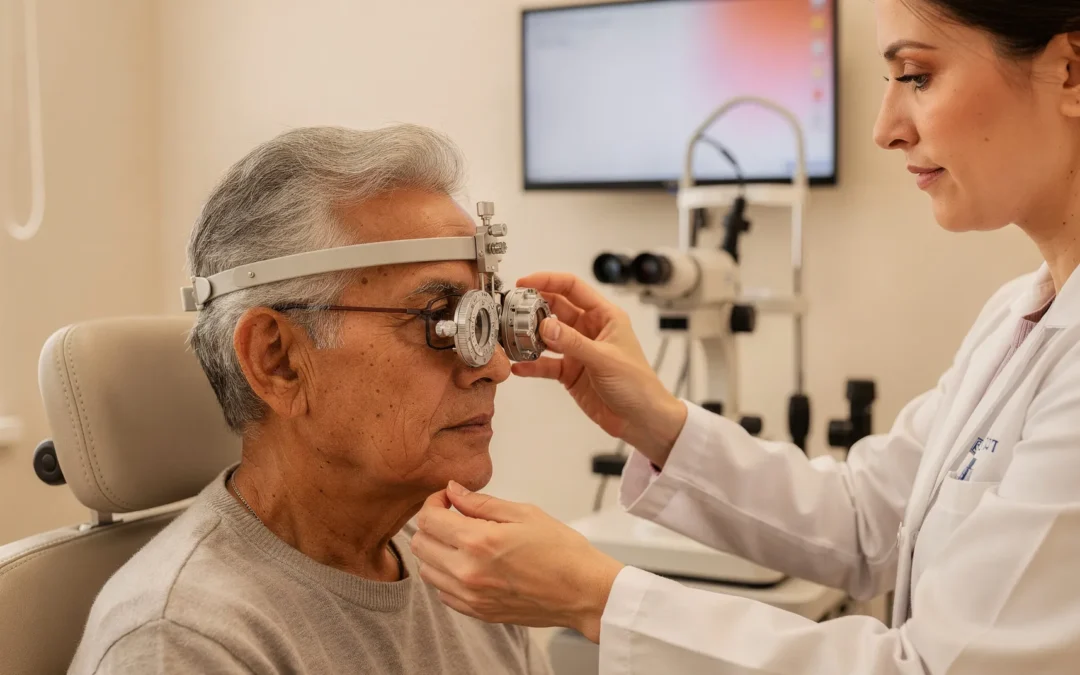
Refraction helps determine your prescription for corrective lenses if you need them. During the test, you look through a phoropter while different lenses are placed in front of your eyes. The clinician changes the lens choices and asks which option looks clearer, such as whether the first or second view is easier to see.
Your response is part of the measurement. Say when one option looks clearer, when two choices seem similar, or when the view remains blurry. Do not choose the answer you think the clinician wants; describe what you actually see.
Refraction is commonly used during a glasses-focused visit, but it is not a universal requirement for every appointment. The purpose of the visit, your symptoms, your measured vision, your current prescription, and the clinician’s judgment can affect whether refraction is performed. If you are attending only to discuss a concern or a stable prescription, ask how the planned evaluation will address that purpose.
The 20/20 description is based on reading a standard eye chart from 20 feet; the seventh line from the top of most charts is described as 20/20. That chart result does not replace the lens comparison used in refraction. A clear distance-chart result and a need for a particular prescription are related but not identical questions.
Separate a prescription check from eye-health evaluation
A prescription check and a broader eye-health evaluation answer different questions. A glasses-focused visit may involve preliminary testing, visual acuity, refraction, eye-muscle and pupil checks, an eye-health evaluation, and discussion of results and options. A comprehensive eye exam checks how clearly you see, how well your eyes work together, and whether your eyes are healthy; it can detect some problems that may not cause noticeable symptoms at first.
A vision screening can be a useful first step, but it does not replace a comprehensive eye exam. Screening may miss near-vision, eye-coordination, or focusing problems. If your goal is broader reassurance about eye health, say that when you schedule rather than assuming that a distance-vision check covers every concern.
Additional testing may be recommended depending on your specific needs. A comprehensive eye exam can assess visual acuity and refraction, include dilation, and screen for eye conditions and diseases, but the exact combination of tests can vary. If you are experiencing dry eyes, specialized testing may evaluate tear production and tear quality. If you are concerned about computer vision syndrome, the clinician may assess focusing and alignment at close distances.
Ask what each recommended test is intended to evaluate and how its result affects the next discussion. That question keeps the appointment connected to your symptoms and visual goals without assuming that every visit includes the same tests.
For adults under 40 with no risk factors, the recommended interval for comprehensive medical eye evaluations is 5–10 years; interim vision examinations such as refractions may occur during those periods. That interval is general guidance for the stated age and risk group, not an individual schedule. Symptoms, risk factors, and a clinician’s judgment can change what type of evaluation you need and when.

Leave with a usable results plan
Your results discussion should connect the findings to decisions you can make. Ask the clinician to explain which findings relate to glasses, which relate to eye health, and whether anything needs follow-up. If the prescription changes, ask what has changed and how the change relates to the vision problems you described.
Your results checklist can include these questions:
- What did the visual-acuity measurements show for each eye?
- Was refraction performed, and what does it indicate about corrective lenses?
- Did the evaluation identify a reason for the symptoms or visual difficulty you described?
- Is additional testing recommended, and what question would it address?
- Should you arrange a follow-up visit, and what change should prompt you to contact the practice sooner?
- What information should you give to the optical provider or bring when ordering glasses?
Write down the answers in plain language. A usable plan should tell you what to do next, what remains uncertain, and which symptoms or changes deserve a new conversation.
Your next step may be as simple as obtaining the updated prescription, arranging an additional evaluation, or following the schedule the clinician recommends. Do not choose glasses based only on a chart number if your symptoms, work demands, or near-vision needs still need discussion. Ask for clarification before leaving when the recommendation is not clear.
Your written results plan can use three short headings: prescription, eye health, and next action. Under “prescription,” record whether your glasses prescription changed and what type of vision it addresses. Under “eye health,” record any finding or additional evaluation the clinician discussed. Under “next action,” record the follow-up timing, the question that remains unanswered, and the symptom or change that should prompt you to contact the practice. This format gives you a practical note to use when ordering glasses or arranging another visit.
Clarify the appointment and refraction charges
Your appointment and refraction charges should be discussed before testing when the billing arrangement is unclear. Ask what the scheduled exam includes, whether refraction is part of that visit or billed separately, and which insurance or vision-plan questions you need to address. Ask for an explanation of any expected out-of-pocket amount before you proceed rather than guessing from the name of the appointment.
Your insurance information can help frame the conversation, but coverage decisions belong to your plan and the responsible billing process. Bring your insurance card and referral information if your plan requires one. You can ask whether the office needs anything else from you, which service is being scheduled, and whom to contact if your plan distinguishes a medical eye evaluation from a glasses-focused refraction.
Costs can depend on the service requested and the terms that apply to your plan. If the office cannot answer a coverage question, ask which responsible authority can provide the answer before the appointment.
Your billing conversation can follow a simple sequence:
- Name the type of visit you want, such as a new prescription, a prescription update, or a broader eye-health evaluation.
- Ask whether the visit includes refraction and whether that service is billed separately.
- Ask which insurance card, referral, or prescription records you should bring.
- Ask which expected charges remain subject to your plan and which questions must be directed to the insurer.
This sequence helps separate the clinical purpose of the appointment from the payment questions. It also gives you a clear point to pause and request an explanation before testing begins.

Know when a routine glasses exam should wait
Your symptoms and risk factors should determine whether an online glasses test is even an appropriate option. Online tests can measure the power of an eyeglass prescription, but they cannot detect eye diseases that often have hidden symptoms. If you have symptoms or risk factors such as diabetes or a family history of glaucoma, see an ophthalmologist rather than relying on an online glasses test.
Online vision tests may be appropriate for adults aged 18–39 who have non-severe corrective eyeglass prescriptions and no symptoms of eye disease. It does not recommend those tests for anyone under 18 or for adults aged 40 and older. Adults aged 18–39 still need comprehensive eye exams every 5–10 years even without symptoms or risk factors. These age ranges are guidance for the stated conditions, not a substitute for deciding what your symptoms require.
Sudden or serious eye symptoms call for prompt qualified care rather than a routine prescription update. Suddenly seeing repeated flashes of light, especially when accompanied by cloudy floaters or vision changes, could be a serious problem. Floaters and flashes can sometimes be a sign of retinal detachment. If you notice regular floaters and flashes, contact Brooks Eye Associates. For eye pain, seek a professional diagnosis from a qualified ophthalmologist.
Do not wait for an ordinary glasses appointment to raise a sudden vision change, repeated flashes, cloudy floaters, or eye pain. Contact a qualified eye-care professional or the responsible urgent-care authority promptly when these symptoms occur.
Consider the local appointment path
Your local appointment options can include Brooks Eye Associates in Plano or Las Colinas. If you live in Plano, Las Colinas or Irving, Frisco, McKinney, Dallas, or a surrounding North Texas community, describe the reason for the visit when you request care. You can explain whether you need a glasses prescription, have noticed a change in vision, or want broader attention to eye health.
At Brooks Eye Associates, we provide comprehensive evaluations and make recommendations based on your lifestyle, ocular health, and long-term vision needs. That conversation can include the visual tasks that matter to you, the symptoms or changes you have noticed, and the questions you want answered about testing and follow-up. The evaluation does not establish a prescription before you are examined; it gives the clinical team a basis for discussing appropriate recommendations.
Your appointment request should identify the location you prefer, the purpose of the visit, whether you are seeking a new or updated glasses prescription, and any symptom that changes the urgency. If you are arranging an exam for someone else, include the relevant age, current eyewear information, and reason for the request without trying to diagnose the concern yourself.
Request the next step toward clearer vision
Your next step is to gather your current eyewear, prescription records, medication list, insurance information, and symptom notes, then request the type of evaluation that matches your reason for the visit. Bring your questions about refraction, broader eye-health testing, follow-up, and charges so the appointment can end with a plan you understand. A qualified eye-care professional must decide what evaluation and treatment suit your individual circumstances.
What should you confirm before requesting an eye exam for glasses?
Does 20/20 vision mean I do not need a full eye exam?
No. A 20/20 result describes one measure of distance clarity. It does not by itself assess near vision, focusing, eye coordination, symptoms, or overall eye health. A clinician can explain whether a broader evaluation is appropriate for your age, history, symptoms, and risk factors.
Should I wear my contact lenses to an eye exam for glasses?
Bring your contact lenses, case, solution, related prescription information, and current glasses. If you wear contacts regularly, ask the office whether you should wear them to the appointment; instructions can depend on the purpose of the visit and the evaluation being planned.
Can an online vision test replace an in-person eye exam?
No. An online test may measure the power of a glasses prescription, but it cannot detect eye diseases that may have hidden symptoms. Do not rely on one if you have eye symptoms, diabetes, a family history of glaucoma, or other eye-disease risk factors; arrange qualified in-person care instead.
What should I do if the clinician says a refraction is not needed?
Ask how the planned evaluation addresses your reason for visiting and whether your current prescription, symptoms, or measured vision suggest any change. Refraction is commonly used to determine or refine a glasses prescription, but it is not required at every visit. Your clinician decides based on your findings and the purpose of the appointment.