
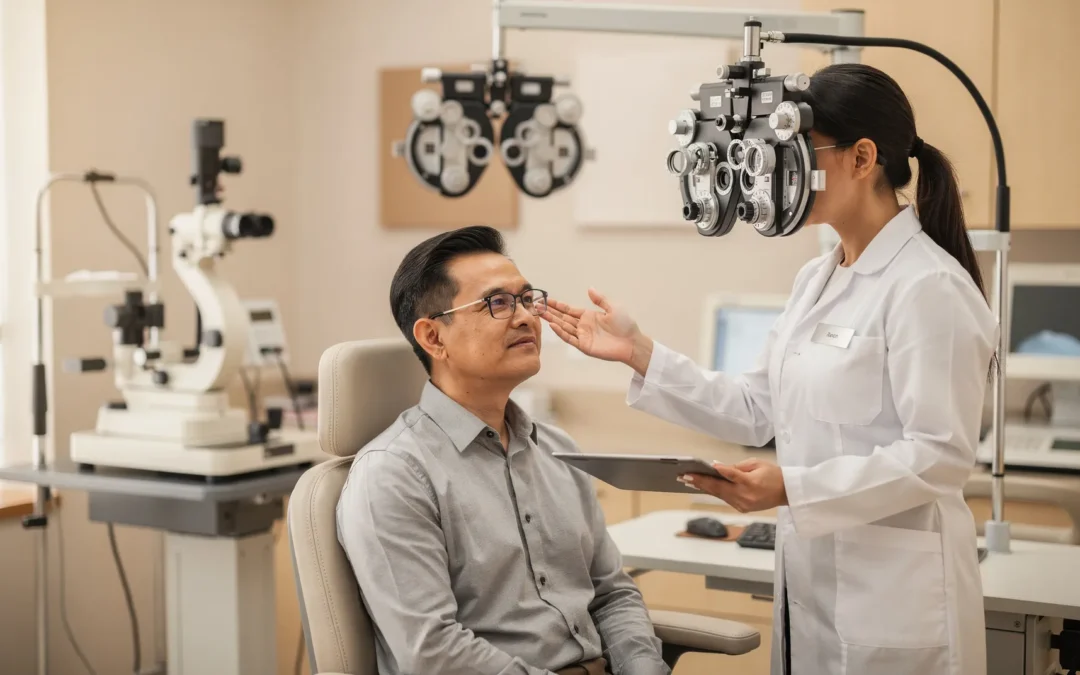
What a “normal” eye-examination result can—and cannot—mean
A normal eye-examination result is not a single number that proves your eyes are healthy. A visual-acuity result such as 20/20 describes how clearly you see details at 20 feet, and 20/20 is used as a standard reference for normal distance vision. A Snellen score measures central, distance-related clarity; it does not assess peripheral vision, which can matter when clinicians evaluate conditions such as glaucoma.
The main parts of an eye examination answer different questions:
- Visual acuity: How clearly you can see at a stated distance.
- Refraction: What lens power may correct nearsightedness, farsightedness, or astigmatism.
- Eye pressure: One measurement that can contribute to glaucoma assessment.
- Broader eye-health findings: Whether other structures and functions need attention, including findings that a chart score cannot identify.
A result can be typical for one measurement and still require discussion in another part of the examination.
A complete eye examination provides broader context than visual acuity alone. Normal visual acuity does not necessarily mean your eyes are healthy, because the score by itself cannot identify elevated eye pressure, retinal tears, or abnormalities in the eye’s blood vessels. Treat the acuity number as one answer to one question, then ask what the rest of the examination showed.
Read the visual-acuity fraction as a comparison of clarity
A U.S. visual-acuity fraction describes how your distance vision compares with the chart standard. The top number is the distance between you and the chart, while the bottom number is the last line you read correctly. In a 20/20 result, you read at 20 feet the line considered normal at 20 feet; in a 20/40 result, you see at 20 feet what normal vision sees from 40 feet away. Visual acuity decreases as the bottom number gets larger.
A Snellen visual-acuity test asks you to read letters aloud from a chart designed for 20 feet, and reading more lines indicates better measured distance clarity. A 20/15 result means you can read at 20 feet what most people with 20/20 vision would need to stand 15 feet away to see clearly. The first number remains the chart distance; the second number compares your clarity with the reference standard.
The fraction is useful only when you know how and where it was measured. Ask whether the result was recorded for distance or near vision, whether you were wearing your usual correction, and whether each eye was tested separately or together. A change from 20/20 to 20/40 is a change in measured chart clarity, not by itself a diagnosis of the reason for that change.

Separate visual acuity from prescription strength
Visual acuity measures how well you see, while a prescription describes the lens power used to correct refractive error. Your eye doctor may measure uncorrected vision without glasses or contacts and corrected vision with them. You could test at 20/200 without glasses because of nearsightedness or farsightedness and then see clearly with the right prescription; the uncorrected number therefore does not tell you how clearly you can see with correction.
Refraction determines the lens power needed for nearsightedness, farsightedness, or astigmatism, then refines that power from your responses about which lenses look clearest. Diopters measure the refractive power of a lens. Larger numbers in the Sphere or Cyl columns mean a higher prescription, while lower numbers mean your vision needs less optical help from glasses or contacts.
A prescription number is not a visual-acuity score. A higher diopter value describes greater lens power; it does not, by itself, describe your eye health or establish how well you will read an acuity chart. When you review a prescription, ask which values apply to each eye, what correction was used during the acuity test, and how the lens power relates to your day-to-day vision.
Uncorrected visual acuity describes how your eyes perform without corrective lenses, not the full value of your eyesight or eye health. For an uncorrected test, you remove glasses or contacts, sit or stand 20 feet, or 6 meters, from the chart and keep both eyes open. Visual acuity may be greater or less than 6/6, which is expressed as 1.0; a 6/6 result does not necessarily measure the highest clarity you can achieve because smaller chart symbols are not tested after that line is reached.
The distinction between uncorrected and corrected vision also matters when you see a very low uncorrected result. Someone who is nearsighted or farsighted may test at 20/200 without glasses yet see clearly with the right prescription. Legal blindness refers to best-corrected vision, so an uncorrected score should not be interpreted without knowing how well correction improves the result.
Put 20/20, 20/15, and “better” vision in perspective
A 20/20 result is a reference point, not a promise of perfect overall eyesight. A 20/15 result is sharper than the 20/20 reference because you can see at 20 feet what someone with 20/20 vision sees at 15 feet. The result describes distance acuity only, so a sharper line on the chart does not automatically answer questions about every other visual function.
A 20/15 or 20/20 result does not establish whether your peripheral vision, depth perception, color vision, or other aspects of eyesight are normal. Even 6/6 vision or better, including 20/15 or 20/10, may coexist with a need for correction for problems such as hyperopia, ocular injuries, or presbyopia. Ask what the acuity result explains and what other measurements were performed.
A sharper-than-reference result does not eliminate every reason you might need correction. Focusing problems such as presbyopia can affect near vision even when distance acuity is strong, and an eye examination may identify a useful prescription for a concern that the distance chart does not reveal. Interpret 20/20 or 20/15 as a description of one visual task, not as a complete label for your eyesight.
Account for age, test method, symptoms, and baseline
The test method affects what an eye-examination result represents. The Snellen chart is the most common distance-acuity test, with progressively smaller rows read from 20 feet. A directional Random E test may be used when letters are not practical, and young children may use cards with symbols or letters. Distance acuity is typically measured in the clinic, while near acuity may be measured in an outside-clinic consultation setting.
Age changes the meaning of some visual complaints without making every change abnormal. Beginning in the early to mid-40s, many adults develop trouble seeing clearly up close as presbyopia changes the eye’s focusing ability; this change continues to progress over time and is among the most common problems adults develop between ages 41 and 60. Some children lose 20/20 vision around age 8 or 9, after which visual acuity usually stays similar for many people, although it may decrease slightly in the 60s or 70s.
When you compare an old result with a new one, compare like with like. Note whether each result was:
- Measured with glasses or contacts, or without them.
- Taken at distance or at near.
- Obtained with a letter chart, a directional test, or a child-focused symbol chart.
- Recorded when you had symptoms, fatigue, or eye strain.
Those details can change the meaning of the numbers and help you ask whether a difference reflects testing conditions, a prescription change, or a finding that needs more assessment.
Your usual vision, health history, and symptoms also matter when you interpret a result. Visual acuity can fluctuate with fatigue, eye strain, or certain underlying health conditions, and frequent changes in visual clarity may be associated with diabetes or hypertension that can damage tiny retinal blood vessels. One estimate reports that about 35% of adults have 20/20 vision without glasses, contacts, or eye surgery, while about 75% have 20/20 vision with correction; those figures describe adult groups, not a personal target or diagnosis.

Read the rest of the examination before connecting results to LASIK
Eye pressure is a separate measurement from visual acuity. Most people who have glaucoma have pressure higher than 21 mmHg, but glaucoma can also occur with pressure between 10 and 21 mmHg, a pattern called normal-tension glaucoma. A pressure result therefore belongs with the rest of the eye examination rather than functioning as a stand-alone verdict about eye health. The 21 mmHg figure is not a universal dividing line between healthy and unhealthy eyes.
If a pressure or acuity result seems unexpected, ask which additional findings support the interpretation and whether follow-up testing is needed.
A LASIK evaluation examines more than your ability to read an eye chart. The evaluation should include a complete eye examination, a full medical and ophthalmologic history, and informed consent. Sufficient corneal tissue is necessary because LASIK reshapes the cornea, so corneal assessment adds information that a visual-acuity fraction cannot provide.
A normal visual-acuity score does not establish suitability for LASIK or another vision-correction procedure. A qualified professional must assess the broader eye findings, including the measurements and history relevant to the proposed procedure. Use a clear acuity result as useful background, not as a surgical decision.
Turn an unexpected result into a useful conversation
Routine eye examinations remain useful even if you do not wear corrective lenses or have a known eye problem. The American Academy of Ophthalmology recommends a complete eye examination every 5 to 10 years for adults under 40. Your own interval may depend on your symptoms, history, and examination findings, so use the appointment to clarify the timing that fits your situation.
An unexpected eye-examination result becomes easier to understand when you ask focused questions. Take the written measurements with you and ask:
- Which measurement changed: visual acuity, refraction, eye pressure, or another part of the examination?
- Was the result measured with correction, without correction, at distance, or at near?
- Does the result call for repeat or additional testing?
- How does my age, health history, or usual vision affect its interpretation?
- What lens power does the refraction indicate, and what does that mean for glasses or contacts?
- If I am considering LASIK, which parts of the evaluation still need to be assessed?
Stereoscopic acuity is your ability to detect differences in depth with your two eyes. For more complex targets, stereoacuity is similar to normal monocular acuity, at around 0.6–1.0 arc minutes, yet stereoacuity may be very poor or absent even when each eye’s monocular visual acuity is normal. Ask about depth perception separately if your work, driving, sports, or daily activities make it relevant.
The purpose of the conversation is to connect each number with an action or a boundary. You might need a prescription discussion, repeat testing, broader eye-health assessment, or a separate evaluation before considering vision correction. Ask what has been established, what remains uncertain, and what timeframe applies to the next assessment.

Know when symptoms change the timetable
Sudden vision loss changes a routine follow-up into an urgent eye-care issue. Unexpected sudden vision loss in one or both eyes, whether partial or total, is a medical emergency, and eye pain with vision loss calls for immediate ophthalmology care. Seek immediate attention for sudden vision changes, sharp pain, severe redness, swelling, discharge, light sensitivity, or contact-lens complications.
If you suddenly see more floaters than usual with bright flashes, seek immediate eye care because the combination may indicate a retinal tear requiring immediate treatment. Repeated flashes are especially concerning when they occur with cloudy floaters or vision changes.
After an eye injury or sudden vision change, avoid rubbing or applying pressure to the affected eye. If contact lenses cause redness or pain, remove them and do not reinsert them until an eye-care professional advises you.
Eye problems account for 2% to 3% of primary care and emergency department visits, and the right response depends on the symptoms accompanying your examination result. A normal-looking acuity score should not delay care for sudden changes, pain, flashes, new floaters, or other symptoms that require prompt assessment.
Choose the next appointment that matches the result
A next appointment should match both the examination result and the reason you are seeking care. If you live in Plano, Las Colinas in Irving, Frisco, McKinney, Dallas, or a surrounding North Texas community, bring your measurements, health history, symptoms, and written questions to a qualified eye-care professional. A complete evaluation is the appropriate next step before you make a vision-correction decision, including a decision about LASIK. A qualified eye-care professional must determine how your individual findings affect suitability.
A familiar number can orient you, but the meaning of an eye-examination result comes from the measurement, the testing conditions, your baseline, and the rest of the examination. Arrange follow-up at the timeframe a qualified professional recommends for an unclear result, and seek immediate qualified eye care when sudden symptoms or vision loss change the timetable. Individual suitability for treatment requires that professional assessment.
Questions to ask about an eye-examination result
Is 20/15 vision normal?
Yes. A 20/15 result is sharper than the 20/20 reference for distance acuity: you can see at 20 feet what someone with 20/20 vision sees at 15 feet. It describes central distance clarity only, so it does not establish normal peripheral vision, depth perception, color vision, or overall eye health.
What does a 20/200 eye-exam result mean?
It means that, at 20 feet, you can see what a person with the reference vision can see from 200 feet away. Whether it was measured with or without glasses or contacts is essential: someone with an uncorrected refractive error may see clearly with the right prescription. Ask about the best-corrected result and whether additional examination is needed before interpreting the number.
Can a normal eye-exam result still matter for a LASIK evaluation?
Yes. A normal acuity score is useful background but does not establish LASIK suitability. A separate evaluation considers the complete eye examination, medical and ophthalmologic history, and corneal findings, including whether sufficient corneal tissue is available for the procedure. Individual suitability must be determined by a qualified eye-care professional.
When should an unexpected eye result be evaluated urgently?
Seek immediate qualified eye care for sudden partial or complete vision loss, eye pain with vision loss, sudden increases in floaters, repeated flashes with floaters or vision changes, or sudden blurry vision. After an injury or sudden change, do not rub or press on the eye. If contact lenses are associated with redness or pain, remove them and do not reinsert them until an eye-care professional advises you.