
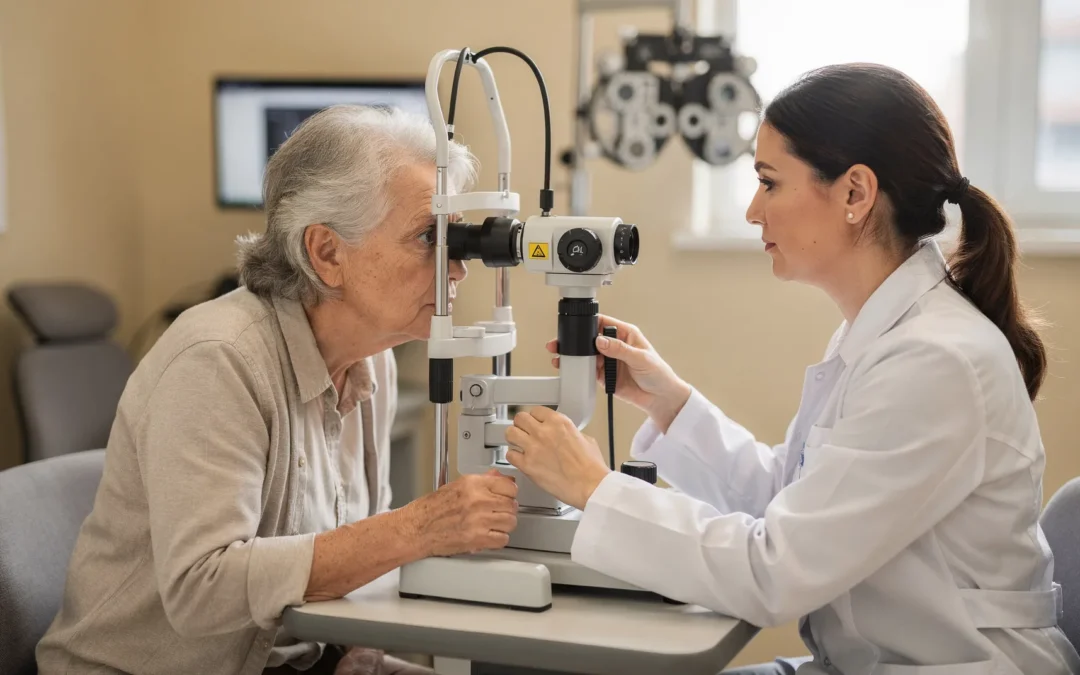
Understand how an eye examination guides your care
An eye examination is a connected process that starts with your history and visual concerns, moves through vision and eye-health testing, and ends with a discussion of findings and possible management. A comprehensive eye evaluation includes a history, examination, diagnosis, and discussion of management. It can assess eye disorders, refractive error, ocular disease, and possible systemic disease related to the eyes.
The exact path depends on why you are being seen, your age, your health history, your symptoms, and the date of your last examination. Your appointment may therefore include several familiar checks plus focused testing selected for your situation. The goal is not to reduce eye health to a single letter-chart result; it is to give the eye-care professional information for deciding what should happen next.
That sequence also gives you useful points for questions. You can describe what brought you in, learn what each test is assessing, and leave with a clearer understanding of whether you need a prescription change, further evaluation, management, or follow-up.
Cost planning: The amount you pay can vary with the scope of the examination, whether dilation or additional diagnostic testing is needed, your copay, and whether vision or medical insurance applies.
Recommended examination timing depends on your symptoms and risk factors, so age-based intervals apply only to asymptomatic adults without eye-disease risk factors.
Diabetes changes the timing question. For people with diabetes, examination timing depends on diabetes type and pregnancy status. The guideline states that the first examination for type 1 diabetes is 5 years after onset and yearly thereafter, while the first examination for type 2 diabetes is at diagnosis and yearly thereafter. For women with type 1 or type 2 diabetes, the first recommended adult comprehensive medical eye examination is prior to conception and then early in the first trimester of pregnancy. These intervals are planning information, not a substitute for discussing your own schedule during an appointment.
Prepare the information and eyewear that shape the visit
Preparing for an eye examination mainly means bringing information that helps the clinician understand your symptoms, health, and current vision correction. You do not need to prepare as you would for surgery, but a short checklist can make the appointment more useful.
Before you leave for the appointment, gather:
- A list of your current medications, vitamins, and supplements.
- The health conditions that may affect your eyes or general care.
- Your current glasses or contact-lens information, as applicable.
- A previous prescription if you have one.
- Insurance cards and identification requested for check-in.
- Notes about symptoms, when they began, and whether they are changing.
- Relevant family eye-health history and questions you want answered.
- Sunglasses if dilation may be part of the examination.
Bring the medication and health-condition list even when your appointment seems routine. Your eye doctor may use that information when deciding which questions to ask and which parts of the evaluation are relevant. Glasses, a previous prescription, symptom notes, and family history can also give the clinician useful context.
After dilation, close-up vision may be blurry for several hours. If you need to coordinate work, reading, driving, or another commitment, ask the office about the likely scope of the visit and whether dilation may be included. If dilation is required, one patient-education source advises planning for 90 minutes for the comprehensive eye examination.
Write down your questions before you arrive. Useful questions include what each planned test assesses, whether you should bring prior records, whether dilation is expected, and when you will discuss the findings. The list does not have to be long; it only needs to capture details you may not remember during the appointment.

Start with your history and visual priorities
Your eye-health history gives the clinician a starting point for the rest of the examination. Your eye doctor may ask about the reason for your visit, current symptoms, medical and family history, lifestyle, visual needs, and use of glasses or contact lenses. History taking may also include other health and demographic information, recent changes in visual function, and the health professionals involved in your care.
Describe the problem in practical terms. You might explain whether you are having trouble reading, seeing at a distance, working at a computer, driving, tolerating contact lenses, or managing a new visual symptom. Include when the change began and whether it is present in one eye or both if you know. You do not need to diagnose the cause; your description helps the clinician decide which questions and examinations deserve attention.
Mention both the main concern and any related change that seems minor. A gradual change in near focus, recurring discomfort, increased light sensitivity, or difficulty with a familiar visual task can add context to the reason for your visit. Your health history can alert the clinician to medication allergies, current or family histories of systemic or eye pathology, and environmental conditions affecting your vision or eye health. Mention those details even when they do not seem connected to the appointment, because they can help shape the questions and evaluation.
Your answers can change the direction of the visit. History taking is interactive, so your responses may guide the clinician to ask additional questions and pursue additional evaluation. A family history of eye disease, a medication list, diabetes, prior eye treatment, or a change in visual needs may make a focused assessment more relevant than a standard sequence alone.
Answer as specifically as you can, and say when you are unsure. Accurate uncertainty is more useful than guessing. If you wear contacts, mention how often you wear them and any discomfort or visual change you have noticed, because contact-lens use is part of the visual and eye-health history.
You can also explain what you need your vision to do each day. A professional who knows that you spend long periods at a computer, read fine print, drive at night, or alternate between near and distance tasks has more relevant context for the discussion that follows.
Measure how clearly you see at near and far distances
Visual acuity testing checks how clearly each eye sees, usually with charts read at near and far distances. You typically cover one eye while the other eye is tested, then switch sides. The result describes clarity at the testing distance; it does not by itself describe the health of your retina, optic nerve, eye pressure, or other structures.
A result such as 20/40 uses 20 feet as the standard testing distance. The bottom number represents the smallest letter size you were able to read, while normal distance visual acuity is 20/20. That fraction is a measurement of visual sharpness under the test conditions, not a complete statement about your eye health.
The visual-acuity result helps the clinician decide whether to examine refractive correction more closely and how your reported visual needs compare with the chart measurement. A change from a previous result may be worth discussing, but the number needs to be interpreted alongside your symptoms, history, and the rest of the examination.
Tell the clinician if the letters look blurred, doubled, or distorted, or if one eye seems markedly different from the other. Those descriptions add context that a single line on the chart cannot provide. If you normally use glasses or contact lenses, the clinician may compare your corrected and uncorrected vision as part of the examination.
Check visual function beyond sharpness
Preliminary eye tests may check depth perception, color vision, eye movements, side vision, and how the pupils respond to light. The examination can also assess how your eyes focus, team together, and move. These checks address visual functions that a distance letter chart does not measure.
The clinician may ask you to follow a target, compare colors, respond to what you see at the edge of your field of view, or focus at different distances. The exact activities vary with your history and the purpose of the visit. A test may be included because of a symptom, a visual task you described, a previous result, or a finding during the appointment.
The meaning of any individual result comes from the full examination rather than from a standalone score. Tell the clinician about difficulty shifting focus, losing your place while reading, eye strain, double vision, unusual light sensitivity, or problems judging distance. These details can help connect the functional checks with the visual priorities you identified during the history.
You can ask whether a finding relates to focusing, eye teaming, movement, side vision, or another part of visual function. Naming the function in plain language can make the results discussion easier to follow and gives you a specific point to include in future appointments.
Refine the prescription when refractive correction is needed
Refraction testing determines the lens power needed for nearsightedness, farsightedness, or astigmatism. The clinician compares lens options while you identify which view is clearer, helping refine the correction that addresses the refractive error being measured.
Refraction is one part of an eye examination, not a substitute for the broader eye-health assessment. A clearer view through a tested lens can answer a prescription question while leaving other questions—such as why your vision changed or whether an eye condition is present—for the rest of the examination.
Your prescription discussion should match how you use your vision. Mention whether you need correction for distance, reading, computer work, driving, or more than one task. If you use a home vision test, an optometrist or ophthalmologist must approve any corrective-eyewear prescription.
A high-power or irregular prescription is a reason to skip home vision tests and schedule an examination with an ophthalmologist or optometrist. A prescription decision should follow professional assessment rather than a home result alone.
Bring your current glasses or contact-lens information so the clinician can understand what correction you use now. A prescription change should be discussed alongside your symptoms, visual demands, and the broader eye-health findings.
Examine eye health and select additional tests when appropriate
Additional tests may be recommended when your history, symptoms, risk factors, or examination findings make them appropriate. The parts of a comprehensive eye examination vary according to your age, date of last examination, and other factors, so not all parts may be needed or performed at every visit.
Eye pressure is one example. Tonometry measures pressure within the eye and may use a quick puff of air or a pressure-sensitive tip near or against the eye. Numbing drops may be used for comfort. Ask what a recommended test is assessing and how its result fits with the rest of your evaluation.
A focused test is not a sign that every possible test is required. It is a way to examine a particular question raised by your history, symptoms, risk factors, or findings.
Dilation widens the pupils so the retina and optic nerve can be examined. The examination may use a special lens to provide a view of structures inside the eye, including areas relevant to eye disease. Your eyes might be sensitive to light, and close-up vision may be blurry for several hours afterward.
Diabetes is one reason examination timing needs individual attention. Discuss the schedule that applies to you during an appointment.
Plan for dilation and what happens after the examination
Dilation can affect your plans after an eye examination. After the examination, your close-up vision may be blurry for several hours, and dilated pupils can make your eyes sensitive to light. Bring sunglasses if dilation is expected, and consider arranging a driver or other transportation when light sensitivity or blurry near vision would make your usual travel difficult.
Dilating drops typically take around 20 to 30 minutes to take effect and may last up to several hours after the examination. Individual effects vary, so ask the office what to expect for the type of visit you are scheduling. Plan for 90 minutes if dilation is required for your comprehensive eye examination.
Use the appointment discussion to make a practical after-visit plan. If you need clear close-up vision for work, reading, or another task, avoid placing that task immediately after a visit when dilation may be used. Keep your sunglasses accessible, and ask when the clinician expects your vision to return to its usual state.
Post-examination effects do not tell you whether the examination found an eye condition. The clinician should explain the findings, any recommended management, and the follow-up plan separately. If you are unsure whether dilation is planned, ask before the appointment so you can plan your time and transportation.

Know why a vision screening is not a comprehensive examination
A screening result does not answer every eye-health question. If you have symptoms, a history of eye disease, a risk factor such as diabetes, or a change in vision, arrange the type of professional examination that fits those circumstances rather than treating a screening as a complete evaluation.
The distinction matters when your goal is more than checking whether you can read a particular line. An examination can bring together your history, visual function, prescription needs, eye pressure, internal eye structures, and other findings as appropriate.
A home vision test has a narrower role. If you have a high-power or irregular prescription, skip home vision tests and schedule an examination with an ophthalmologist or optometrist.
Do not use a home result to explain new pain, flashes, floaters, a dark area, or another sudden visual change. Those symptoms call for qualified eye care rather than a prescription update. A home result also cannot replace the discussion of findings and follow-up that comes after an in-person examination.
Use the results discussion to clarify management and follow-up
The results discussion connects measurements to your next decision. A comprehensive medical eye evaluation includes careful and thorough detection and diagnosis of ophthalmic disorders, and it develops a treatment plan for refractive error and ocular disease. It may also evaluate ocular manifestations of systemic disease and lead to timely diagnosis, intervention, or referral when necessary.
Ask the clinician to explain:
- What the examination found and which findings matter for your visual needs.
- Whether your prescription needs to change.
- Whether additional testing or evaluation is recommended.
- What management options apply to the finding being discussed.
- When follow-up should occur and what change should prompt an earlier call.
- Whether another medical-care professional should receive information about a possible systemic issue.
Write down the plan in the terms you understand. A result is most useful when you know what it means for the next appointment or action.
Your clinician should interpret your examination results and determine which treatment applies to you. The clinician may refer detected systemic disease to the appropriate medical-care professional. Follow the follow-up interval and management instructions given for your own findings rather than substituting a general age-based schedule.
Before leaving, make sure you know whether you need a prescription update, another test, a referral, management for an eye condition, or a routine return visit. If the explanation is unclear, ask for the finding and next step to be stated in plain language.
Change course when symptoms need prompt eye care
Sudden visual symptoms should change your plan from routine scheduling to prompt qualified eye care. Seek prompt ophthalmic attention for sudden new or increasing flashes, flashes with dark spots or cloudiness, a dark curtain across your vision, or flashes after an eye or face injury. Call an ophthalmologist for an eye infection, injury, eye pain, or sudden floaters and flashes.
New sudden floaters and flashes could mean a torn or detached retina, a very serious condition that an ophthalmologist must treat quickly. A dilated eye examination is the only way to tell whether vitreous detachment has caused a serious eye problem, so go to an eye doctor right away if you notice symptoms associated with it. Do not wait for a routine appointment to address these changes.
When you contact qualified help, describe what changed, when it began, whether it is getting worse, whether one or both eyes are involved, and whether an injury occurred. That information helps communicate the urgency of your situation. Loss of side vision may be a symptom of glaucoma, and it can occur without you noticing it. A person may not notice loss of side vision, so mentioning side-vision concerns during a routine visit gives the clinician relevant context.
An injured eye needs protection while you arrange medical help. Do not press or rub an injured eye, try to remove an embedded object, or use cotton swabs or tweezers on the colored part of the eye. Get medical help right away for an embedded object.
Do not delay care while trying to identify the problem at home. If your vision is impaired or travel is difficult, arrange help getting to the appropriate medical service and explain the injury or symptom when you call.

Arrange an examination that fits your situation in Plano or Las Colinas
An eye examination gives you a clearer care path when you bring relevant information, describe your visual priorities, understand the purpose of each test, and leave with a specific plan for findings and follow-up. Routine scheduling is appropriate when you need an examination and do not have sudden, severe, painful, worsening, or otherwise concerning symptoms; urgent symptoms should take priority.
At Brooks Eye Associates, we provide medical and surgical eye care using the latest technology and techniques. We strongly recommend regular eye examinations and thorough glaucoma testing. If you need routine or medically indicated eye care in Plano or Las Colinas, have your reason for the visit, symptom notes, medication list, eyewear information, and questions ready when you arrange the appointment.
An ophthalmologist or optometrist should interpret your examination results, decide what follow-up fits your findings, and explain any management or referral that applies to you. Use prompt eye care instead of routine scheduling when the warning symptoms above occur.