
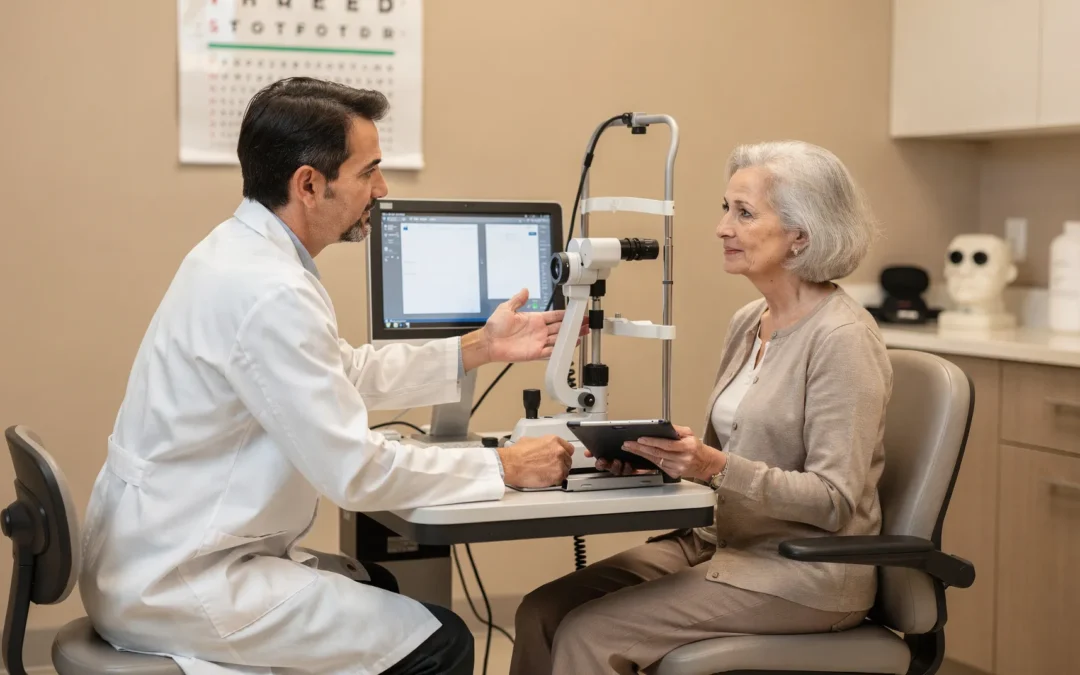
Begin with the difference between aging and vision loss
Age-related vision changes can include difficulty focusing up close, trouble distinguishing certain colors, and needing more light or more time to adjust when lighting changes. Some of these changes can often be corrected with glasses, contact lenses, or improved lighting. Early signs of eye disease and changes in vision often begin at age 40.
Vision loss is not a normal part of aging. The practical distinction is simple: ordinary changes may affect how you focus or adapt to light, while a new, worsening, or function-limiting change deserves professional attention.
A national poll of older adults shows why corrected vision and eye health should be considered separately. In that poll, 86% of older adults reported wearing glasses and/or contact lenses. The same surveyed group included 64% who rated their corrected or uncorrected distance vision as excellent or very good and 56% who rated their corrected or uncorrected near vision that way. These figures describe what people reported about their vision; they do not establish whether an eye disease was present.
Your first planning question is therefore not only whether you can read a chart or manage familiar tasks. Ask whether your vision has changed, whether daily activities have become harder, and whether your last comprehensive evaluation still matches your age and risk factors.
Map the conditions that can affect everyday vision
Age-related eye conditions can affect different parts of vision, so a symptom alone should not be used as a diagnosis. A useful general map includes:
- Cataracts: Cataracts cloud the eye’s lens and can cause blurry vision, reduced contrast, difficulty seeing in low light, duller colors, and increased sensitivity to glare.
- Age-related macular degeneration: AMD damages the macula and can blur central vision. Reading, driving, recognizing faces, and close-up work may become more difficult when central vision is affected.
- Diabetic retinopathy: Diabetic retinopathy damages blood vessels in the retina. Diabetes also increases the need for planned eye monitoring.
- Dry eye: Dry eye occurs when the eyes do not produce tears properly or tears evaporate too quickly. If untreated, it can lead to pain, ulcers, or corneal scars.
With age, the risk of age-related macular degeneration, cataract, diabetic retinopathy, and glaucoma increases. That does not mean that every visual change reflects one of these conditions. It means that persistent or unexplained changes belong in an eye-care discussion.
Poor vision is more likely to be associated with falls, social isolation, and decreased independence. The effect may appear in ordinary tasks before you describe it as serious: reading medication labels, seeing steps in dim light, recognizing a face across a room, driving, or moving safely through the home.
One national estimate for adults age 40 and over lists 24.4 million with cataract, 7.7 million with diabetic retinopathy, 2.7 million with glaucoma, 2 million with age-related macular degeneration, and 3 million with low vision. These estimates are presented as conditions among adults age 40 and over, not as a prediction of your personal diagnosis. In a national poll, about one in four older adults, or 27% of surveyed older adults, reported a diagnosis of cataracts, glaucoma, macular degeneration, or diabetic eye disease.
The same poll found differences in whether primary care providers asked about vision: 50% of people with household incomes below $30,000 reported being asked, compared with 40% of people with incomes of $30,000 or more; among people with a history of eye disease, the figures were 49% versus 39% for people without that history. If a vision concern has not come up in another appointment, you can raise it yourself.
Why a normal-looking day does not rule out disease
Many age-related eye diseases have no warning signs or symptoms early on. You may still read, walk around the house, and complete familiar tasks while a condition requires attention. A comprehensive dilated eye exam can detect some eye diseases before they cause vision loss or blindness, which is why the absence of discomfort does not establish that your eyes are healthy.
An ophthalmologist can diagnose and treat a wide range of eye diseases beyond routine eye and vision care. Regular comprehensive examinations by an ophthalmologist can detect some eye diseases early, even when you have no symptoms. The purpose is not to label every ordinary change as disease; it is to assess your eyes rather than relying only on how your vision feels on a particular day.
A baseline eye disease screening may detect eye diseases common in adults age 40 and older and may provide a greater chance for early treatment and preservation of vision. If you have no eye problems or risk factors, see an eye care professional for a baseline eye disease screening every 5 to 10 years before age 40, even if you have no vision problems. Your schedule after that point depends on age, symptoms, medical history, and risk factors.
For people with diabetic retinopathy, guidance reports that early detection, timely treatment, and appropriate follow-up care can reduce the risk of vision loss by 95 percent. The figure applies to diabetic retinopathy care, not to every eye condition or every person with diabetes. If you have diabetes, planned dilated examinations should be part of your medical-care conversation rather than something you arrange only after vision changes appear.
Set a routine evaluation rhythm without treating it as a fixed rule
Routine examination intervals vary across professional guidance, particularly for adults age 65 and older without symptoms or known risk factors. Guidance differs for asymptomatic, low-risk adults age 65 or older: the cited AOA guideline recommends an annual comprehensive eye and vision examination, while cited AAO guidance lists a comprehensive medical eye evaluation every 1–2 years; these are differing professional recommendations rather than a single universal interval. Other recent comprehensive eye-evaluation guidance gives the same 1–2-year interval for asymptomatic adults in that age group.
These differences are a reason to discuss your schedule with an eye-care professional, not a reason to choose the longest interval automatically. Symptoms, family history, diabetes, glaucoma risk, prior findings, and examination results can change the appropriate plan.
For adults without eye-disease risk factors, general planning intervals are:
- Under age 40: every 5 to 10 years.
- Age 40 to 54: every 2 to 4 years.
- Age 55 to 64: every 1 to 3 years.
- Age 65 or older: every 1 to 2 years in the cited AAO-related guidance.
Adults with risk factors for glaucoma, including diabetes mellitus, older age, family history, Black race, and Latino or Hispanic ethnicity, may need more frequent comprehensive medical eye evaluations. Use these intervals as a prompt for planning, not as a substitute for an individualized schedule. A new symptom or a known condition can move your next evaluation earlier.
Know what a comprehensive visit is designed to assess
A comprehensive eye exam can include more than a measurement of how clearly you read letters. Depending on your situation, the visit may address:
- your medical and family history, including eye conditions and general health;
- your medications and the visual demands of work, hobbies, driving, or daily activities;
- visual acuity and refractive status, which help assess the need for corrective lenses;
- eye focusing, eye teaming, eye movement, color vision, peripheral vision, and the response of the pupils when appropriate;
- the health of the front and back portions of the eye; and
- additional testing selected for your symptoms, findings, age, or risk factors.
During a comprehensive dilated eye exam, drops widen the pupils and an eye-care professional uses a special magnifying lens to look for signs of eye disease. Dilation is one part of the examination, while the complete evaluation combines history, vision measurements, eye-health assessment, and any needed testing.
A visual-acuity screening alone is not a substitute for a comprehensive eye and vision examination. Reading an eye chart can describe one aspect of sight, but it does not by itself assess every part of eye health or establish the cause of a change.
Eye pressure is another example of a measurement that needs context. Glaucoma evaluation can include a dilated eye exam, eye-pressure measurement, and visual-field testing; eye pressure alone is not sufficient for an accurate diagnosis. If a screening, prescription check, or home observation raises a concern, use it as a reason to arrange the appropriate professional evaluation.

Adjust the plan for diabetes and glaucoma risk
Diabetes is a risk factor that can change the timing of comprehensive eye evaluations. People with diabetes need a comprehensive dilated eye exam at least once a year. That interval is general guidance for people with diabetes; your clinician may set a different plan when examination findings or other conditions require closer follow-up.
Among people age 65 and older in the United States, more than 11 million, or more than 25% of that age group, have diabetes, and more than 3 million adults age 65 and older have diabetic retinopathy. These population figures explain why diabetes belongs in your eye-care history even when your vision seems unchanged. Bring your diabetes history and current medications to the appointment.
Glaucoma risk is higher for Black or African American people over age 40, people age 60 and older—especially Hispanic or Latino people—and people with a family history of glaucoma. More frequent comprehensive medical eye evaluations are also recommended for adults with risk factors that include diabetes mellitus, older age, family history, Black race, and Latino or Hispanic ethnicity.
An evaluation can include dilation, eye-pressure measurement, and visual-field testing because pressure alone cannot establish an accurate diagnosis. Tell the eye-care professional about a family history of glaucoma, diabetes, prior eye findings, or changes in side vision so those factors can be considered together.
Prepare an appointment brief that improves the conversation
An appointment brief gives you a place to collect the details that can shape the evaluation. Bring or write down:
- your main concern and when you first noticed it;
- changes in reading, driving, recognizing faces, walking, medication use, or seeing in low light;
- your medical history, including diabetes and other conditions that may affect your health;
- every medication, eye drop, supplement, and allergy you want the clinician to consider;
- your glasses or contact lenses and their prescription if available; and
- questions about examination findings, testing, follow-up timing, and symptoms that should prompt an earlier call.
The comprehensive eye exam can include medical and family history, visual-acuity measurement, refractive assessment, an eye-health examination, and additional tests as needed. A written list helps keep daily function and long-term concerns in the conversation rather than focusing only on a prescription.
Primary care conversations can help you identify a reason to arrange eye care, but they do not replace a comprehensive eye examination. Among people who received regular medical check-ups, 42% reported that their primary care provider asked about vision, and 17% reported having their vision checked using an eye chart during a primary care visit. People whose primary care providers talked with them about vision or checked their vision were more likely to report an eye-doctor exam in the past two years: 91% versus 77%.
These survey figures describe reported health-care experiences, not a recommended examination interval. Use a primary care visit to mention a change, then bring the same concern to the eye-care professional who can assess the eyes and determine what testing is appropriate.
Use daily function as a reason to reassess routine follow-up
Daily function can reveal a change that is easy to overlook when it develops gradually. Cataracts can cause glare, reduced contrast, difficulty seeing in low light, duller colors, and blurry vision. AMD affects central vision and can make reading, driving, recognizing faces, or close-up work more difficult. Late AMD may make straight lines look wavy or crooked and may cause a central blurry area, blank spots, less-bright colors, or greater difficulty seeing in low lighting.
Some difficulty seeing close-up objects, distinguishing colors, or adapting to dim light can accompany natural aging and may often be addressed with a new glasses prescription or improved lighting. A change that interferes with driving, reading instructions, moving around safely, or maintaining independence is still a reason to reassess your eye-care plan. Do not use the fact that a change is gradual to decide that it needs no evaluation.
Change course when symptoms may be urgent
Sudden or new symptoms should move you out of a routine scheduling path. Arrange prompt qualified evaluation for:
- new floaters or flashes, which should be examined;
- a sudden change in vision or sudden blurriness, which could signal cataracts, AMD, retinal disease, or systemic disease; and
- a sudden shade, curtain, blind spot, halo, or distorted area in your vision.
Contact an ophthalmologist immediately for a curtain or shade moving over your vision, loss of vision, or new or increased floaters. New floaters or flashes should be evaluated promptly even when there is no pain. Do not wait for a routine examination when these symptoms begin.
Sudden blurred vision with eye pain, particularly when the eye is red, is a medical emergency. Seek urgent medical evaluation for sudden blurred vision with eye pain, sudden blind spots, halos, distorted vision, or a sudden shade or curtain over your vision.
Sudden intense eye pain, a red eye, blurry vision, and nausea can occur with angle-closure glaucoma; seek medical care right away if these symptoms occur. These situations call for immediate action rather than an online explanation, a new pair of glasses, or a routine appointment request. If eye pain is significant or worsening, or if you are unsure how urgently to act, contact a qualified eye-care professional or the responsible urgent-care authority promptly rather than waiting for a routine appointment.

Turn the pathway into the next local care step
Your next step is to match the situation to the right level of care: plan a comprehensive evaluation when your schedule or risk factors call for one, prepare your history and questions, and move promptly when vision changes or eye symptoms are sudden. A qualified eye-care professional decides the appropriate interval, testing, and treatment for your situation.
If you are in Plano, Las Colinas (Irving), or surrounding North Texas communities, use the appointment request link to contact Brooks Eye Associates about an eye-care evaluation.
What should seniors clarify before arranging an eye evaluation?
Does Medicare cover a senior eye exam?
Medicare does not cover routine eye exams for eyeglasses or contact-lens prescriptions. Coverage for disease-related evaluations, diagnostic testing, or treatment depends on the service and your plan, so verify the specific benefit before assuming it is covered.
What can affect the cost of senior eye care?
The cost can depend on whether the visit is a basic vision check or a comprehensive medical eye exam, whether dilation or additional testing is needed, and whether the visit involves a disease evaluation, treatment, or a glasses or contact-lens prescription. Retinal imaging may involve an extra charge. Ask what the visit includes and which services may be billed separately before proceeding.
When should an older adult get an eye exam instead of buying stronger reading glasses?
Arrange an eye examination when reduced vision is new, worsening, unexplained, or interfering with daily activities.